Wednesday, April 27, 2011

Shanghai, China March 1-June 19 Week 8

The weather has been quite pleasant recently, but I’ve been inside most of the week feverishly preparing for my upcoming residency at National Taiwan University of Arts. I have been asked to deliver three distinct lectures, so I decided on the following topics:
Cross-Cultural Approaches to Composition: a brief historical background to cross-cultural approaches to composition, focusing specifically on works of mine that I refer to as "hybrid soundscapes." A brief discussion of the ethics of cross-cultural composition, an increasingly important topic. 
Japanese Music Today: a discussion of three rubrics of musical activities in Japan that briefly help to understand the development of Japanese music from the 19th-century to the present, and time allowing, conclude with a brief introduction to my compositions as a example of the third category.
     The “East” looking “West”
    The “East” Looking “East”
The “West” Looking “East”
Japan Looking Across Genre Boundaries
Composing for Japanese Instruments: a discussion of my works for Japanese instruments, with special focus paid on how I incorporate traditional Japanese musical aesthetics
It has taken an inordinate amount of time to prepare for these lectures. Although I have presented all of them before in various context and venues, since Chao-Jung Wu, otherwise known as “Zoe”–my host at National Taiwan University of the arts–must prepare a Chinese translation, I prepared not only a detail Keynote presentation, but also lecture notes to guide her. This is one set of presentations where I’ll probably stick to the script in consideration of my interpreter. Putting these presentations together has truly been a cathartic experience for me, as it has forced me to put my ideas into an articulate, “fixed form.” I am hoping these lecture notes can serve as the base for a book or journal article in the future. 
I heard this week that I am one of five participants accepted to the 2011 Gugak Workshop in Seoul, Korea from June 19-July 1. The program consists of lectures on various elements of Korean traditional music and dance and instrumental lessons by renowned professionals. The program covers all expenses, including tuition, hotel, food, and a R/T plane ticket for a modest $200 participation fee. Amazingly, the College Music Society International Conference runs from July 2-10 and I have arranged to study kayagum with Yi Ji-young of CMEK after the conference is over for 2-3 weeks, so this means I will likely spend five weeks in Korea in a wonderfully efficient and fulfilling clockwork schedule. With the R/T plane ticket benefit, this means I won’t even have to foot the bill for my flight back to the USA mainland.

On Saturday, April 23rd I went to a live house concert at M50 Creative Park. It was a wonderful space that evidently produces CDs under the independent label Bandu. It was a concert of contemporary music for the guzheng. I met two friendly Japanese people named Rina and Hirobe and afterwards we went out for some dinner at Simply Thai in Xintiandi. Before the food even arrived I started to feel sick, and realized that whatever I ingested at the live house was aggravating my stomach. I think it was some stale beer–which I thought was apple juice–mixed with carbonated soda. I excused myself for a few minutes during dinner but was probably in the men's room for a good 15-20 minutes. I started sweating profusely and felt gurgling in my stomach. It was so bad at one point I considered asking the restaurant staff to call an ambulance and admit me to an emergency room. I took off most of my clothes and drifted in and out of various states of consciousness. I felt better after a while and returned to the table, but the smell of that delicious food made it worse and within 15 minutes I was in the men's room again. After that I called it quits and begged my newfound friends to take me home, as I wasn’t confident I would survive the taxi ride. We managed to flag down a taxi right away, but the driver was nasty, screaming at us the entire time and insisting that we tell him exactly how far he had to drive along Fuxing Rd. before pulling over. With some drivers it is simply not enough to say, “Please drive straight.” I was very grateful that Hirobe was with me because I wasn’t in the mood to be barked at like a wild animal. Like my food poisoning incident a few weeks ago, I slept a restless night and felt better in the morning, but took it quite easy on solid foods. 

Shanghai, China March 1-June 19 Week 7

When I was in Narita Aiport I was thinking about purchasing underarm deodorant. However, these types of products are so expensive in Japan and the selection is quite limited. In the end, I decided to wait until I returned to China. My flight back to Shanghai was smooth and eventless. Once I landed it was a fiasco with countless numbers of taxi touts attempting to give me a ride back to the city center. I knew that the Maglev was not running but thought that the subway might be, so I made it across the ground transportation terminal. The gates were closed on both the Maglev and subway, so I contemplated what to do. Never look like you don’t know where you are going in China, because someone will evidently come up and try to “help” you. And this is what happened. I stupidly engaged in pointless conversation with one tout who insisted that there was “no bus.” I knew however, that line 2 would bring me directly to Jing’an temple for just 22RMB, and of course there was a bus waiting just downstairs. The ride was terrifying but at that time of the evening it took just 30-35 minutes or so. I caught a cab quickly from the bus terminus and made it into bed shortly after midnight. 
The next day I went to my friendly–not–neighborhood supermarket and attempted to search for underarm deodorant. There was nothing that resembled deodorant so I attempted to gesture to a clerk that I was looking for something to apply under my armpits. She recommended something in the form of a spray that had a nozzle that looked like it could be underarm deodorant, so I picked it up and went on my way. For the next few days I applied this spray to my armpits. The first thing I noticed was that, even though it smelled pleasant, it burned a bit. When I went to Kong’s import shop on 77 Fen Yang Rd. the next evening the clerk there even complimented me on how good I smelled. However, when Jing came over the next day I learned the error of my ways. She also complimented me on how good I smelled, and I proudly showed her the bottle of “deodorant” I bought. At this point Jing broke out laughing and in a moment I learned why. Since I am supposed to know Japanese, Jing was surprised that I didn’t catch the Chinese character for the word 虫(むし), or “bug.” For three days I had been applying mosquito repellent in heavy quantities under my armpits, and although it smelled pleasant it did indeed burn. That evening she took me to a drug store that sold underarm deodorant, and now I have an entire bottle of mosquito repellent just in case! This is what life in Shanghai is every day. You never know what is going to happen.


On Saturday, April 16th, I spent all day with my Chinese teacher, “Dolly,” and her husband, “Thomas.” We met at 10:00AM at Xiaonanmen (line 9) and made our way to the annual Eco-Design Fair. 

“Eco Design Fair is a bi-annual grass-roots community event whose purpose is to showcase eco-conscious designers and products to general consumers. Started in 2008, the Eco Design Fair is the city’s first such initiative that provides the community with green tools to support restorative, environmentally-positive design and lifestyles. Upon entering the fair visitors are introduced to a dynamic retail and educational environment, where people from the city can shop for quality sustainable, organic, natural, non-toxic, recycled, ethical, energy-saving, and environmentally friendly products all at one central place. The Eco Design Fair also serves as a local hotspot, where thousands of families come to shop for innovative designs for the home and family. Fathers can browse eco building material companies to improve their homes. Children can learn how the cycle of nature constantly renews itself, and mothers can shop for the latest in fashion and watch models strut down catwalks wearing the readily available clothes. Teenagers can also listen to live music acts, and finally cool down at the farmer’s market selling ingredients that will eventually be part of a fully natural dinner.”
I bought an exquisitely designed eco shopping bag and some delicious coconut sorbet. Afterwards, we took a taxi to M50 Creative Park, a collection of 50+ galleries housed in reconstituted warehouses, a haven for cutting-edge Chinese urban art. There were a number of quite stellar galleries, with monumental-sized pieces on exhibit in the space. Our favorite was the 1300℃ Color Galaze Space, which specialized in beautiful porcelain work. We spent almost all day looking around the complex and I don’t think we missed any galleries! We didn’t realize that M50 Creative Park is in walking distance to Shanghai Railway Station, so we walked up the road and caught a bus to a suburban area where Dolly and Thomas live with Dolly’s Mom and Dad. Mom served up a delectable Chinese dinner, and I tried to be a polite but lively guest. The father recently suffered a stroke and according to Dolly is quite shy, but he was in good spirits and seemed to enjoy the table conversation.  After watching Shutter Island–a movie with quite an unexpected twist!–I made my way back home in no time at all. The closest subway station–Fanghua Rd.–was 8 kilometers up the road, and from there it was less than 30 minutes back to Changshu Rd.
Just across the street from M50 Creative Park


Sunday, April 10, 2011

Tokyo, Japan April 5-11

I did some last minute shopping at Pudong Airport, had some delicious crab roe Chinese buns, and boarded my Delta flight for Tokyo. The flight was smooth and eventless and we even arrived 30 minutes early. I made my way through immigration and customs like I have done dozens and dozens and of times in the past. I decided not to list “tourism” as the purpose of my visit. I mean, is that really believable in the aftermath of the terrible triple tragedy that has befallen Japan? Instead I checked “other” and wrote “visiting friends.” The customs official asked me the purpose of the visit and I explained that I lived in Japan a long time and have countless numbers of friends who I wanted to pay a visit to. He let me pass with a smile, I rented a cell phone at the AU desk, withdrew some cash from an ATM, and made my way downstairs to the trains. The first thing I noticed was that the Narita Express was not running at all, and evidently the Keisei Skyliner had only resumed its normal schedule the day before. From March 11th to April 4th, the shuttle buses were the only public transportation to and from the airport. When I arrived in Ueno, the first thing I noticed at the JR station is that none of the escalators were running. At first I thought that perhaps they were broken, but when I took a closer look at the sign posted at the entrance to the escalators I realized that this is one of the ways for Tokyo to conserve energy. In addition, the lights were turned off in the Yamanote line cars. Dragging my luggage up and down the stairs I felt inconvenienced in a minor way, but it’s a small price to pay to help in the recovery efforts.
I arrived at my hotel in Kagurazaka, the Agnes Hotel and Apartments just past 3:30PM, and a clerk from the kimono cleaners was waiting for me. I unloaded my kimono, hakama, and related accessories and checked in. I’ve always wanted to stay in this hotel, a hidden gem tucked away in the backstreets of Kagurazaka. After unpacking and taking a refreshing shower, I took a walk in my old neighborhood, stopping by a number of stores to say hello to friendly faces, such as Sada. In the evening I enjoyed dinner at Arbol, down one of Kagurazaka’s most famous cobblestone streets. I’m not sure if the recent events in Japan have given the Japanese people time for reflection, or if if it is just because I’ve been in living in Shanghai, but Tokyo feels much less rushed and stressed out than it usually does. People seem to be a bit more polite than I’m accustomed to, and it is simply a shock for me to see all traffic actually stopping at stop lights and yielding to pedestrians.
Side entrance of Agnes Hotel and Apartments
On Wednesday, April 6th I had a tempura lunch with Kunihiro Ota, the President of Tamachi and enjoyed a walk around the grounds of the Prince Hotel Shinagawa while viewing the cherry blossoms.


In the afternoon I went to Jeannie Ohmae’s house for a rehearsal in preparation for the upcoming concert on April 9th. 


 (l to r) Rio Tosha, Emi Saeki, and Jeannie Ohmae


On Thursday, April 10th I walked around Kagurazaka for a better part of the afternoon and had lunch at Style ABC, where they remembered me from last summer! In the evening, I met Akiko Sakurai and Tetsuya Nozawa at Shirokane Takanawa and we spend 2-3 hours making a studio recording of Devil’s Bridge (2010) for shamisen and biwa. 


Akiko Sakurai at SRK Studio in Shirokane Takanawa
The term “Devil’s Bridge” refers to ancient bridges found in Europe that have myths or legends relating to the Devil. These legends often involve a bridge builder who makes a pact with the Devil, stipulating that the Devil would build the bridge in return for the soul of the first life to cross the bridge. Musically speaking, this piece is based on idiomatic gestures, driving rhythms, and aggressive playing techniques found in biwa repertoire such as Byakkotai and battle episodes from the Heike monogatari. Using these elements as a base, in this composition I attempted to portray the darkness of the underworld, full of blazing fire, evil, and fear.
Afterwards I treated them to dinner at a family restaurant, and then we took a taxi to Kagurazaka and found a cozy izakaya where we had another round of drinks and food. 
On Friday, April 8th, I met my Canadian composition colleague Daryl Jamieson for breakfast here at the Agnes Hotel and then we went to Meijiro Shakuhachi Shop, where I purchased a cover for my dizi.

In the afternoon I helped Jeannie transport various items over to the Suntory Blue Rose Hall. On the way back, her driver dropped me off in Ichigaya, where the cherry blossoms around Yasukuni Shrine were in full bloom. I walked along the moat back to Iidabashi and was happy to see so many young Japanese enjoying themselves, especially considering the rumors I’ve heard about “flower-viewing” picnics not being allowed in public spaces this year context of the tragedy that has befallen Japan.


Cherry blossoms along the Chuo line
After dropping off some items at my hotel, I made my way to another favorite neighborhood of mine, Azabu-jūban. I stopped in one my favorite boutique shops in all of Tokyo, Blue and White. I bought a stunning indigo-dye scarf and cotton shirt. I then made my way to Sengawa on the Inokashira line–during the rush hour peak!–and had dinner with Christopher Blasdel and Mika Kimula. Afterwards, Christopher and I went for a dip in the local sento. 
Blue and White in Azabu-jūban
On Saturday, April 9th I made my way to Jeannie Ohmae’s house at 10:00AM and we were driven to Suntory Blue Rose Hall. Jeannie celebrated her 60th birthday–an important event known as “kanreki” in Japanese–with a concert featuring works that I have composed for her and her friends. It was an all day affair. I dressed up in kimono and hakama–mercifully, professional kimono staff were on hand!–and conducted my composition Kaien (2006) for two shinobue, piano, and kotsuzumi. 


Several people commented that it was likely the first time in history that anyone has conducted in a kimono! They also performed the short version of “The Tale of the Bamboo Cutter” for two shinobue and narrator. It was a wonderful concert, and the hall was filled with over 350 friends and family. Afterwards, there was a reception held across the way in a beautiful space with stunning views of Tokyo. This concert was the main reason I came to Tokyo this week. 


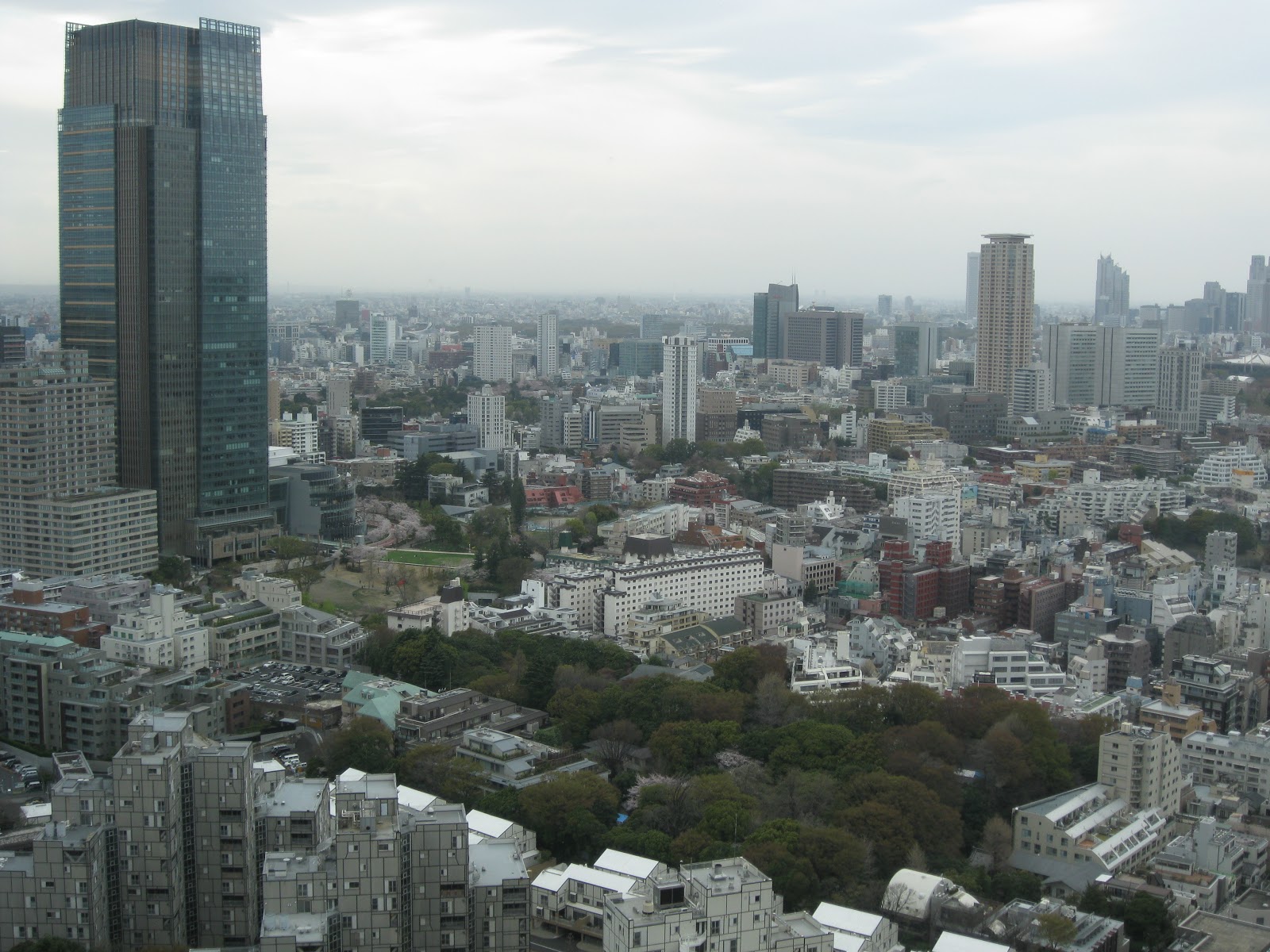
View from the reception room
I had such a wonderful trip to Tokyo. I cannot believe that I was actually thinking for a moment of canceling my trip, moreover at the height of the cherry blossom season! It will be difficult to get back on that plane to Shanghai, where the language barrier creates a constant stress in my daily life and I have very few friends, not to mention the poor air quality and fear of being run over by a car or some indescribable vehicle ignoring the traffic laws (what traffic laws!) Nevertheless, assuming I don’t extend my stay past May 21st, I only have 5-6 weeks left so I’ll try to make the most of it and concentrate on learning Chinese instruments and various composition projects. Goodbye Japan!


Well, yesterday (Aprill 11th) didn’t go quite as planned. I boarded the Keisei Skyliner at Ueno, and as soon we arrived at Nippori station, the capital was rocked by another earthquake. It took 30+ minutes for them to conduct a safety check on the line before continuing. When the train finally did start to move, it crept along at a snail’s pace. Needless to say, I arrived at the airport just 15 minutes before my plane was scheduled to depart. The train couldn’t even proceed to the terminus. All passengers had to get out at terminal 2 and take a shuttle to terminal 1. By the time I arrived at the Delta counter, it was too late. I was rebooked on the same flight the next day and had to stay the night in a hotel near the airport. It was cold and rainy last night so I had dinner in an izakaya inside the hotel. I slept very well, but shortly after getting up the hotel was rattled by another aftershock! It was one of the larger earthquakes that I’ve experienced in my life. I can’t fathom how frightening the earthquake on March 11th must have been. My flight doesn’t leave until the evening so I plan to enjoy cherry blossoms at the nearby Shinshōji temple in Narita City.

Tuesday, April 5, 2011

Shanghai, China March 1-June 19 Week 5

This week did not get off to a good start at all. On Tuesday, March 29th, Jing and I had lunch at a Chinese restaurant I’ve been wanting to try. Within an hour our stomachs were groaning and for the rest of the day we sat in my apartment in utter agony suffering from food poisoning. We thought about going to the hospital, but it was so bad at one point that one of had to use the bathroom every five minutes. We wouldn’t have survived the cab ride, let along the lines that would be sure to be waiting for us at the hospital to receive treatment and fill a prescription. In the end, what would a doctor prescribe for food poisoning anyway? In most cases, all you can really do is take it easy, drink water, and allow your body to get rid of whatever toxins you’ve ingested. The problem was that as of 8:30PM last night I couldn’t even hold down water, so I was worried that perhaps I would be dehydrated. I made a decision to try to sleep it off through the night, and if I didn’t feel better by the morning I’d go to the hospital (again!). Although it was a long night, plagued by pounding headaches brought on by dehydration, after 11+ hours of sleep I felt much better. I bought a sports to drink to replenish electrolytes lost and fasted for the day. When I went to the convenience store to buy this sports drink, I gave the store clerk a hearty “Good morning!” in Chinese. She looked confused and started looking through various cigarette brands. How on earth could I possibly screw up such a basic greeting? I managed to get across to her that I was merely greeting her and we had a good laugh over it. Later on, my Chinese teacher informed me that customers rarely greet store clerks in China, but I then realized the main reason why she was confused. I said “wan shang hao” (Good evening) instead of “zao shang hao” (Good morning)! 
In the afternoon I went for a walk along historical Fumin Rd. and found a number of interesting shops, including Madam Mao’s Dowry, The Pottery Workshop, Le mieux, and The Herb Store. In the evening, I met my new found friend James from the Johnson Club and his girlfriend. Before going to out to dinner we stopped at the restaurant where I caught food poisoning yesterday and politely attempted to tell them about what happened. Despite my best attempt to be tactful and diplomatic, I think they took it the wrong way. This was exacerbated by the fact that a customer overhead our conversation and shouted out in defense that it indeed was a good restaurant. I explained that I wasn’t angry or seeking to blame anyone, but rather that I thought they should know. In more ideal circumstances, it would have been better to speak with the manager of the restaurant in private. Afterwards, we had dinner at Sheng Sushi, where we told the manager of the store about my experience at the restaurant around the corner and catching a horrible case of food poisoning. He said that the same thing happened to him and he was out for two days! 
Although the worst of the food poisoning passed in the middle of the night, 12 hours after it initially struck, it took a couple of days for me to get my appetite back. In retrospect, I nearly fasted for half the week. When I started to eat again I took it quite slowly, avoiding meat, fish, and oily foods. It seemed to make sense then, to make a visit back to the Anna Maya’s on Dongping Rd. This time I was served directly by the kind owner, who made recommendation based on the unstable state of my stomach. While she was speaking English, in the middle of a sentence she said, “Chotto matte kudasai” (Please wait). I asked her if she was Japanese (in Japanese!) to which she replied, “Why yes I am!” After that the conversation was conducted in Japanese and it was–believe it or not!–such a relief to be able to communicate. I mean, we were communicating in English before that but I am usually reserved when speaking English to someone in a restaurant because their vocabulary and context in which they use English may be quite limited. Turns out she has lived in Shanghai over 15+ years and will be starting up a yoga studio towards the back of the restaurant in April or May. When I told her I played the shakuhachi she became excited and asked if I would play for the opening celebration of her studio. We exchanged name cards and I am happy to say that I made a friend. 
Throughout the rest of the week I tried a number of other restaurants in the area. I miraculously was able to get a seat at Goga (short for Golden Gate) and although it was the most expensive meal of my stay so far it was quite delicious. I had the lobster roll and grilled shrimp salad. It is owned and run by a hefty native Californian who looks over his kitchen like a hawk. Their was a a loud bachelorette party going on at the next table so it wasn’t exactly what I’d call a relaxing meal, but I suppose you can’t expect that in a restaurant this small (there can’t be more than 20 seats in the entire place). I also enjoyed lunch at Lapis Lazuli and La Boulangerie, a French Bakery on Yongkang Rd. At La Boulangerie I met another expat, Laurent Meffre, who consoled me on my experience getting food poisoning. He said these days even Chinese people are cautious about eating at just any Chinese restaurant. Unfortunately, standards of cleanliness in the kitchen are evidently just not up to par. Over the weekend I went shopping at Tianzifang (twice!) for souvenirs and small gifts for my friends and colleagues who I’m planning to meet in Tokyo next week.

Shanghai, China March 1-June 19 Week 4

While spring has evidently arrived on the east coast of the United States, this week has brought the coldest weather yet since my arrival. Biting temperatures in the mid-30s combined with freezing rain and grey skies makes for a not so pleasant day. I had my second pipa lesson today (Monday. March 21st) and my teacher asked me how much time I have to practice. When I responded that I have about 30 minutes for each instruments that I’m studying, she kindly asserted, “You should practice more!” I didn’t mean to offer this by way of excuse, but I reiterated my purpose for studying Chinese instruments. The pipa is probably the most difficult of the instruments I’m studying. However, when played well the pipa has a magical power to instantly transport a listener to a distant soundscape. The young woman whose lesson I sat in on before me has evidently been playing pipa since the age of five. It’s a bit ambitious of me to think that I will progress quickly enough to play anything that involves complex voiced chords or dextrous right hand techniques within three months. Nonetheless, we’ll see where these three months leads me in the future in my work with Chinese instruments.
Tonight I began my course at Miracle Mandarin. My teacher, a young Chinese man nicknamed “Jack,” seems to enjoy what he does very much, and although the material covered today was review for me, I really don’t feel that I grasped the material well enough during the fall semester at Texas A&M when I took a crash course in Chinese offered through the Confucius Institute. I’m also taking private Chinese lessons while I’m here, but I feel that the structured curriculum of the Miracle Mandarin may better help me acquire basic grammatical patterns. Together with my private lessons, I hope to make at least moderate progress on my Chinese while I’m here. When class was over, I was shocked when I walked outside to discover the my new bike was stolen! It was locked too, but someone must have just picked it up and walked off with it. Oh well! This is not the first time I’ve had something stolen from me and it’s probably not the last time either! I was really enjoying getting around on that bike, and the nearest supermarket is really too far to walk on a regular basis. For another $75, I’ll probably pick up another bike and buy a lock that will allow me to attach it to a pole or something. 
Today, Tuesday, March 22nd, I had private lessons on the erhu and dizi. My erhu teacher Chen Chuyuan determined pretty quickly that the folk song I was working on was too difficult for me. On the erhu, there are a number of things you must focus your attention on. First, maintaining intonation with left hand pressed positions is extremely difficult. Without frets to guide you, it really takes time to become accustomed to the distance required to play a particular pitch. Even if you can play it relatively in tune, the pressure that you exert with your left fingers to some extent determines the quality of your sound. Chen mentioned that I should have deep indentations on my fingertips as evidence of the pressure I should be exerting on the string. And then there is the right hand! As if maintaining a stable intonation wasn’t enough to keep one occupied, you have to continually press down on the bow with the fingers of the right hand to maintain quality of tone, use the length of the bow for maximum volume, and last but certainly not least, remember to alternate between up bows and down bows! As for the dizi, when I practice I feel a similar sensation to when I first started practicing the shakuhachi 10+ years ago. I am not using air efficiently, and as a result my tone is thin and I’m suffering from oxygen deprivation. Forget about the upper octave! I can’t produce any pitches in the upper octave without overblowing, a sure sign that my lip muscles are not developed. What I’m concerned about is because the embouchure required for the dizi is so different from the shakuhachi, I can hardly produce a sound on the shakuhachi after practicing the dizi. My teacher Wang Jun-Kan says that a period of adjustment is necessary, but it is scary to think that I’ve come this far on the shakuhachi just to have my progress undermined by the dizi. After all, this is why I decided NOT to continue lessons on the shinobue. After my dizi lesson, Jing and I went to a “hidden” copy store down a dark alley off of West Fuxing Rd. and made an electronic photocopy (JPG) of my passport for my upcoming trip to National Taiwan University. We also picked up the Chinese translation of Dr. Witzleben’s book “Silk and Bamboo" Music in Shanghai: The Jiangnan Sizhu Instrumental Ensemble Tradition. I discovered through my librarian at Texas A&M that we have this book in our collection, so I have asked interlibrary loan services to check the book out to me and send it to Shanghai. This may provide some insight as to where I can go about hearing performances of Silk and Bamboo music in Shanghai. I understand that Dr. Witzleben conducted his research from 1981-1985, so I don’t know how dated I’ll find the material, since (!) 25 years has past since then. Nonetheless, it certainly will make for interesting reading during my residency here. 
On Thursday, March 24th, I attended a Jiangnan Sizhu student ensemble rehearsal at Shanghai Conservatory of Music. This ensemble meets every Thursday at 11:30AM and I’m looking forward to sitting in again. I was simply floored at the virtuosity of these student musicians. Although they were being conducted, everyone had their music memorized and the ensemble was tightly coordinated. I was impressed at how they negotiated sudden changes of tempo and dynamic contrast. I’m looking forward to learning more about this music once I receive Silk and Bamboo" Music in Shanghai: The Jiangnan Sizhu Instrumental Ensemble Tradition from the Texas A&M library
Shanghai Conservatory of Music Jiangnan Sizhu Ensemble
Afterwards, Jing and I had lunch at Noodle Bull followed by my weekly massage at Dragonfly. Jing was complaining about her neck and shoulders, so I arranged for her to get a massage downstairs. Afterwards, Jing took me to a charming place I hadn’t even heard of, Tianzifang off of Taikang Rd, located right across the street from exit 1, Dapuqiao Station, subway line 9. The cobblestone streets of this are lined with coffee and tea shops, wine bars, cozy restaurants, galleries, jewelry stores, clothing boutiques, handicraft shops, handmade shoe stores, and more. The shikumen-style architecture takes visitors to an imagined Shanghai of long ago. Don’t be fooled by the exterior! The prices in these shops are not for the faint of heart.


Tianzifang
On Friday night after my group exercise at the Johnson Club, I wandered up Yongkang Rd. further than I ever had before and found a number of surprises. Most importantly, I found a grocery store more conveniently located than the ones beneath South Shanxi station. Although they don’t have imported goods – it’s intended for local Chinese – the prices were the most reasonable I’ve found anywhere. I picked up some breakfast items and snacks and began my daily search for a place to eat. Walking back along Yongkong Rd., I found a hole-in-the-wall sushi joint called Sheng Sushi run by three Chinese guys. A friendly trio, they welcomed me with smiles and an English menu with pictures! They specialize in rolls, and I opted for the aptly named Western Imperial roll, which had mango and avocado as a base. There were two other Americans there and when a phone order came in, one of the chefs passed the phone to one of them because the person on the other end could only speak English. After taking down this person’s order and noting the address – which took an inordinate amount of time – the chef asked him, “Would you deliver it for us too?” We all had a laugh. I will absolutely be going to this place again. It has the best Japanese food I’ve tried in Shanghai and the friendliest service of any restaurant I’ve visited thus far. 
This weekend Shanghai finally started to see some warmer weather, so on Saturday, March 26th I decided to make my way to the center of town, People’s Square Park and the Bund. I forgot how crowded this area can get during the weekend, especially in warmer weather, and how annoying it is for various touts to come up to you and try to see you watches, bags, and other useless items. I decided to play deaf and put on my iPod headphones. Touts still followed me around but it was easier to play dumb this way. I didn’t really find any of the shops interesting on E. Nanjing. Fuzou Rd, just a few blocks south however, was a different story. After checking out the skyscrapers across the river from the Bund, I made my way down Fuzou Rd. The first stores I popped in were Blue Shanghai White and Suzhou Cobblers. Blue Shanghai White prides itself on  hand-painted porcelain wares such as tea cups and trays. Their furniture was quite unique. Suzhou Cobblers sells overpriced, but colorful hand-embroidered slippers and bags. Just down the road on bit on the right was the House of Blues and Jazz, and even further down was the Foreign Language Bookstore. I spent a good hour in this store browsing and leafing through some of the travel guides. I was starting to get exhausted at this point, so I made my way back to People’s Square and took the subway back home. I was so relieved to be away from the bustling crowds and neon lights, and came to realize how lucky I am to have found a place to live in the Old French Concession. For dinner, I finally tried Sasha’s, located in an imposing historic building on the corner of Dongpin and Hengshan Rd. The interior is quite cozy, and I enjoyed a yummy caesar salad and margarita thin-crust pizza. The 2nd floor is simply stunning, boasting an impressive French menu with correspondingly high prices. I’m looking forward to coming here again when they open up the back patio. 
View of Pudong from the Bund

Shanghai, China March 1-June 19 Week 3

On Monday, March 13th, I had my first pipa lesson. A faculty member at Shanghai Conservatory of Music, Shun Yi speaks English very well and was so patient with my technique. I suppose at my age it will be difficult to pick up new instruments easily, but I’ve tried to make clear that my purpose in studying these instruments is not to become a performer, but rather “to acquire a base knowledge of the idiomatic capabilities and strengths of Chinese instruments so that I can continue to compose for them upon my return to the U.S.A. for a network of Chinese colleagues whom I expect to cultivate professional relationships with during my time in Shanghai.” This is how I began to acquire fluency in composing for Japanese instruments nearly ten years ago, and I believe it is by the most effective way to learn how to compose idiomatically for non-Western instruments.


My pipa teacher, Shun Yi
After my lesson, I stopped by Chen Chunyuan’s studio. It was full of students and a wash of erhu sound. George Gao, a famous erhu player based in Toronto, and colleague of Chen’s, was in Shanghai for a couple of days and had evidently stopped by to share his new invention with Chen and her students, a volume resonator for erhu called the shaochin. Without quite knowing what the difference was between a normal erhu and George’s invention, I simply listened and compared. The one with the shaochin attached seemed to have more volume and presence, without the unnatural tone that often accompanies amplified sound. This is evidently achieved by cupping the sound around through the back so that more of the sound vibrations travel above and  in front of the performer rather than escaping out through the back of the instrument. A remarkably example of ingenuity in the world of Chinese music. 
Erhu (side view)


Erhu w/ shaochin extension (side view)
In the afternoon, Chen took me to a rehearsal of the university Chinese music ensemble. They were rehearsing a piece composed by a young Chinese woman, a composition student at Shanghai Conservatory who had won a composition competition and was therefore having her piece rehearsed for performance later in the semester. I was overtaken with the volume and richness of sound emanating from the ensemble. I hope to attend more rehearsals with a score in hand.
Chinese music ensemble
In the late afternoon, I enjoyed Japanese shiatsu and a foot massage at Dragonfly, my third visit since arriving in Shanghai. For dinner I finally had a chance to try out El Gato Verde, a Mexican Restaurant located just around the corner at 66 Fenyang Rd. The beef burrito was a bit spicy but quite delicious. Complemented with a small cup of homemade yogurt with honey, it made a quick but filling dinner. Afterwards, I participated in my first group exercise class at the Johnson Club. I was so afraid that the group exercise space would not be finished as promised, but it actually was! The floor that they laid down is simply gorgeous, a light brown, soft, supple wood, complete with Korean style ondol, or underfloor heating. I was not only the only foreigner, but also the only male in a class full of Chinese women! It was not a problem following the instructions in Chinese, I just used my eyes and imitated what my neighbors were doing.
Since March 11th I’ve been preoccupied with contacting Japanese friends and colleagues in the wake of the unprecedented wave of natural disaster that has befallen Japan. The sheer scope of the disaster is difficult to comprehend. I received responses from all of them within 24 hours, and although Tokyo was spared the brunt of the damage, many Japanese are worried about the future and are quite uneasy. To date the aftershocks still rock the capital. Colleagues and friends of mine in Japan have told me that they have been so impressed with the Japanese people during the last few days, a model for composure and fellowship in the face of adversity. When the earthquake struck and the trains stopped in Tokyo, there was no widespread panic, and commuters calmly lined up to make the trek home by foot without being told what to do. Vendors appeared along the road giving out free tea and miso soup, and the vending machine companies sent workers to open up the vending machines for everyone to have free drinks and snacks. For those that couldn't make it home, they were welcomed with food and a warm place to spend the night by local community centers and other establishments, and many private homes had signs posted on their doors that read, "Please feel free to come in and use the toilet."
On March 16th the US State Department issued a travel warning to Japan, which means that my summer study-abroad program TAMU in Tokyo is at risk of being canceled. I am confident that the Japanese people – with the help of international relief efforts – will come together in solidarity to overcome the hardships they now face as a result of this natural disaster. I wish to remain positive that the program will continue as planned, but we’ll have to see how the recovery efforts pan out over the next few weeks.
Perhaps this is the reason I’ve been having difficult composing this week. I began working on a duet for Yoko Reikano Kimura and Hikaru Tamaki for their summer performance in the USA and Japan entitled 鳥が舞う(‘Birds Dance’), but somehow it is just not coming. Perhaps it is better if I reflect on the disaster that befell Japan last week and compose a Requiem piece for 25-string koto, another piece that I have to complete with the next couple of months. 
On Tuesday, March 15th I took my first lesson on the dizi, the Chinese bamboo transverse flute. I had difficulty producing a stable sound for pitches in the second octave, and it seems like the technique I’ve refined over the last few years on the shakuhachi may get in the way just a bit for my dizi studies. I must remember why I am studying these instruments. It is not because I wish to become a performer, but rather because I want to become familiar enough so that I can compose idiomatically for them.
On Wednesday, March 16th I had my second erhu lesson. My teacher Chen Chunyuan was running late so she sent a student to teach me in her absence, which is just fine for me at the level  I am. In the evening I embarrassed myself at my fitness center when I slipped off the elevated platform in the step aerobics class. Although my gym is a bit “local,” I have been so impressed at the effort that the staff puts into communicating with me to make sure I know what is going on. And believe me, there is always some sort of change! Nothing quite goes on as scheduled. For example, the first day I was taking the “hot” yoga class the portable heater wasn’t working, so the staff desperately searched for someone who could speak English and transmit to me that the yoga class would be conducted at room temperature. There was another time that class was delayed for 30 minutes. It was clear to me that it was delayed but again the staff ran around and found someone who could tell me this. The interesting this is that the communication kept coming. In the 30 minutes I spent on the elliptical trainer, I had no less than four people come up and tell me that class was starting at 7:30PM instead of 7:00PM!
One thing I really like about where I live is that music can be heard from all corners of the apartment complex. Just next door a junior high school practices the violin for hours upon hours a day. Across the way, there is the sound of a saxophone, and around the corner someone is practicing Chinese folk songs on a dizi. This really enchants my daily life. 
On Friday, March 18th I finally registered for a Beginning Chinese course at the Xuhui campus of Miracle Mandarin Language School. It is a ten-week class that meets for two hours twice a week on Mondays and Wednesdays. I’ll have to miss a few class because of short trips to Tokyo and Taipei in the upcoming months, but the course consultant graciously will allow me to make up these classes in exchange private lessons. In the afternoon, Jing accompanied me to the South Bund Fabric Market where we attempted to negotiate for a silk duvet cover and pillow/sham bedding set.  I researched online that these should run about 200 RMB ($30). I was prepared to pay up to 300 RMB ($40) but her initial asking price was a staggering 1,050 RMB ($160). Jing attempted to negotiate for me but the lowest she’d go was 700 RMB ($106), so we decided to forgot about it. These types of products can be bought just about anywhere. 
South Bund Fabric Market
In evening, I found an okonomiyaki (Japanese pancake) restaurant on South Xianyang Rd. The waitress spoke Japanese, which I found reassuring, and the food was quite tasty. I never thought a day would come where I’d actual feel relieved to be able to speak Japanese, almost as if it were my mother tongue!

The weather has been dreary and cold this weekend, but on Saturday I managed to make some progress on “Birds Dance” for koto and violoncello and take part in a “spinning” (i.e. exercise bike) class at my gym. The instructor was an enthusiastic, fit 20-something who really pushed us hard. The class did have a balanced pace to it, but for the routine he expected us to do to the songs at a relatively fast tempo, it was difficult to keep my legs pumping for 4-5 minutes at the same speed of rotation without rest. When he saw one of us lag behind, he yelled something impossible to understand not only because it was in angry Chinese, but also because the music was blaring! Nonetheless, I did get an intense workout. My heart rate was up for 30+ minutes and I was sweating profusely. Afterwards I searched for a new place for dinner, and happened upon Noodle Bull at 291 Fumin Rd., where I enjoyed cold vegetarian noodles, seaweed salad, delicious Yuzu iced tea and Japanese style kakigōri, with azuki beans and an array of unidentifiable Chinese sweets for just 64 RMB ($9.70) in total. I will definitely be going to this restaurant again!