Immediately after the International Gugak Workshop was over, I had one day to pack, move residence, and prepare for the College Music Society International Conference, which started the next day. For the first time in two weeks I enjoyed sleeping into the late morning hours without fighting an alarm clock to get up for an 8:30AM departure to the National Gugak Center. I checked out shortly before 12:00PM and made my way to the northern part of Seoul for my rehearsal with Jeong-min Park, the violoncellist in CMEK (Contemporary Music Ensemble Korea) for our upcoming performance on July 5th. We put Forest Whispers... (2008) together in about an hour or so and I made my way back to the Provista Hotel to pick up my belongings and move to IB Ville in Myeondong, about a 15-minute walk to the conference hotel. I had way too much luggage. Not only did I arrive in Seoul a heavy suitcase, duffel bag, my yoga bag full of shakuhachi and a backpack with my computer and other electronic gadgets, but in the two weeks that I participated in the International Gugak Workshop, they loaded us with three bags of CDs, books, and other materials. Additionally, I purchased a number of CDs and scores myself from the NCKTPA bookstore, not to mention some gifts in Insadong and other areas. In short, I had no less than seven items to carry with me. I could hardly even drag my suitcase from the hotel lobby to the edge of the street, never mind lug those items up and down subway stairs. So I hailed a taxi and sat in traffic for 40 minutes trying to get across the Han River in what is likely the most congested area of town. My taxi driver was quite responsible though. After providing him with the phone number of the guesthouse he was able to navigate through the one-way streets without incident, and we pulled up to my new residence for the next week. The IB Ville was about as bare-bones a place as one could hope for in this part of Seoul. My room was cramped, but the service was friendly enough, the location and price hard to beat, and relatively clean. Some conference participants may have enjoyed rooms in the extravagant Lotte Hotel for 220,00 KRW ($209) a night (!), but I paid 300,000 KRW ($285) for six nights. The weekly conference schedule was even busier than the International Gugak Workshop Schedule. With paper, concerts, and other activities packed from morning to night, how could I justify staying in a five-star hotel?!?!
Registration day (July 3rd) was a nightmare in terms of the weather. It rained cats and dogs all day. Just walking to the Lotte Hotel and back from IB Ville made me completely soaked, and my Birkenstock sandals took 3+ days to dry out as a result! I checked in right at 2:30PM when the registration desk opened, made my way back to my guesthouse for a nap and shower, and then walked back again for the 5:30PM bus departure to the Korea House. We were treated to a wonderful sampling of traditional Korean music and dance. Some of my American colleagues looked at me in surprise when I shouted out a few chuimsae (shouts of encouragement), but Koreans in attendance mentioned that they were pleasantly surprised to witness this and asked me if I was a Korean music scholar! It is interesting how one simple gesture can transmit so much information when performed in the proper context. Dinner afterwards was quite a feast and I was happy to see a few familiar faces and make new friends.
 |
| Welcome Dinner |
The paper sessions began the next morning at Ewha Women’s University. I attended the following session:
9:00 LECTURE-RECITAL: From Night Songs to Dawn Songs (Korean Art Songs in the 1940s)
Jeesun Choi (Konkuk University)
9:30 LECTURE-RECITAL: Experiencing Korean Traditional Music, ‘P’ansori,’ as a Western Style Singer E. J. Choe (Indiana University–Purdue University Indianapolis) Jumi Kim (Cuesta College)
10:00 LECTURE-RECITAL: Young-Ja Lee’s Lyric Songs on Poems by Nam-Jo Kim (Life of Korean Women Artists) Kyoung Cho (University of South Florida) Jeong-Hwa Park (Center for Preparatory Studies in Music)
 |
| Ewha Women's University |
The first plenary lecture was delivered by Sheen Dae-Cheol, who I previously met at the International Gugak Workshop. The content of his lecture, Korean Traditional Music, was similar to the one he gave a few weeks earlier, but I enjoyed it nonetheless and especially enjoyed observing the style of his delivery.
There were a number of papers I was planning to attend in the afternoon, but I was lured away by my dissertation advisor when I was at the University of Hawaii, Manoa, Don Womack, who had a rehearsal with CMEK (Contemporary Music Ensemble Korea) in preparation for Wednesday’s concert. Don was jet-lagged from his flight from Honolulu the evening before, so we took a short rest at our guesthouse before departing. Seoul is a much larger city than it appears on a subway map! I underestimated the time it would take to get across the city, and we were 15+ minutes late. Yi Ji-young, Tom Osbourne and his wife were waiting at Seocho station in a car all that time. Now I know to add another 15-20 minutes to any subway trip estimate I make. I sat in on the rehearsal for 30-45 minutes or so before I made my way back to Ewha Women’s University for the group dinner at Marie.
 |
| CMEK Rehearsal |
In the evening we were treated to a concert of new music by Korean women composers curated by one of the conference organizers John Robison.
Celebrating Korean Women Composers
Concert Manager: John O. Robison (University of South Florida)
Suite “Les douze signes” for solo piano ......................................... Kim Eunhye Cochon
Bin-Nyu-Eum for gayageum and changgo ..................................... Lee Boknam
Icarus Wings for solo violoncello (world premiere) ..................... Park Eun Hye
Paulownia’s Dream to be a sound for solo geomungo ................ Lee Gui-Sook
Variations-Fantaisie” sur le thème du “Salut d’Amour”
d’ Edward Elgar for two pianos (2007) ......................................... Lee Young-Ja
On Tuesday, July 5th I am sorry to report that I overslept and didn’t make it to the early morning paper sessions. By the time I made my way to campus, I was just in time the second plenary lecture, delivered by Lee Young-Jo from the Korea National University of Arts. I was especially interested in this lecture because it was focused on Korean Contemporary Music. However, Dr. Lee seemed to focus on presenting his works rather than discuss the broad landscape of Korean Contemporary Music. In the afternoon I attended the following papers:
1:30 PERFORMANCE: Beyond Borders: Exploring New Dimensions in Solo Piano Composition for the 21st Century Richard Steinbach (Briar Cliff University)
2:00 LECTURE-RECITAL: Developing Korean Piano Repertoire Based on the Traditional Folk Tune “Bird, Bird, Blue Bird” Eunjung Choi (Milledgeville, Georgia) Sumi Kwon (Hansei University)
2:30 PERFORMANCE: Korean and Japanese Works for Four Hands and Two Pianos: Cultures through Music Kumiko Shimizu (Delta State University) Jung-Won Shin (Delta State University)
Afterwards, I met Jeong-min Park had my dress rehearsal for the evening concert. We ended right on time and made our way down the hill to catch the bus, which departed for dinner promptly at 5:30PM. Dinner was none other than bulgogi (surprise!) on this evening, and I enjoyed the opportunity to get to know my performer.
The concert on Tuesday, July 5th consisted of the following pieces:
Five Haiku ........................... Paul J. Dickinson (University of Central Arkansas)
Stefanie C. Dickinson, piano
Flusso .................................................... Kye Ryung Park (Edison State College)
Jieun Lee, viola Enrico Elisi, piano
Prelude and Fugue No. 12 in C-sharp Major “Pentatonic” ...... Michael J. Young (Morehead State University)
Michael J. Young, piano
Forest Whispers ............. Marty Regan (Texas A&M University–College Station)
Marty Regan, shakuhachi Jeung-Min Park, cello
Bar for Hans Sachs ...................................... Justin W. Merritt (St. Olaf College) Jun Qian, clarinet
Suite Antiqua ............................................ Mei-Chun Chen (Taichung, Taiwan)
Jun Qian, clarinet Joanne Hsu, piano
Intrusions ................................... Daniel C. Adams (Texas Southern University)
Ian Davidson, oboe Jessica A. Campbell, bassoon Joohyun Lee, piano
In Silence, Movement ............................... Ka Young Rhee (Bayside, New York)
Jong Hyun Ahn, clarinet Ji Youn Kim, violin Yoon-Kyung Nam, cello Ka Young Rhee, piano
I was happy to have an opportunity to perform Forest Whispers... here in Seoul. Although I didn’t make any noticeable mistakes during the performance, since I haven’t been playing the shakuhachi regularly for some time I felt that my tone was not as polished as it was for past performances. The program notes for this work are below:
Forest Whispers.... (2008) is part of a continuing effort – which began with Song–Poem of the Eastern Clouds (2001) – to devise a notational system that imbues my music with a distinctively Japanese aesthetic. It is designed with an element of rhythmic indeterminacy and uses proportional notation to facilitate a flow of musical time based not on a fixed pulse or meter, but rather than on the natural patterns of the human breath. In this piece, I attempted to seamlessly blend the two instruments in a way that emphasizes their similarities and potential correspondences by means of imitative gestures, resulting in a soundscape where imagined boundaries between the “East” and “West” become blurred and transcended.
At this point in the conference (after just two days!) you could tell that participants were getting tired, so I applaud the conference organizers for including an entire day of sightseeing on Wednesday, July 6th
9:30 AM Arrive Korean Folk Village
10:00 AM Free time to explore Folk Village grounds
11:00 AM Nongak (Farmers’ Dance), Performance Arena
11:30 AM Tightrope performance, Performance Arena
12:00 PM Traditional Wedding Ceremony, House #22
12:45 PM Group Lunch at Mongingak (included)
1:30 PM Bus transfer to National Gugak Center
2:30 PM Hands-on Changgo workshop at the NGC
4:30 PM Workshop concludes/Bus transfer to Lotte
5:30 PM Arrive Lotte
I had enough changgo for one summer, so I excused myself and went to the Impressionism exhibition from the Musee d'Orsay at the Seoul Arts Center during the changgo workshop.
 |
| Vincent van Gogh's Starry Night over the Rhone |
In the evening, there was a cross-cultural collaborative concert between between CMEK and UH Manoa, featuring works that I heard in Honolulu back in February.
Cross-Cultural Collaborative Concert: Contemporary Music Ensemble Korea (CMEK) and University of Hawai‘i Composers
Highwire Act (2009) ..................................................... Donald Reid Womack
Transcending the Sky (2010) ............................................................ Yoko Sato
Park Chi-wan, piri Kim Woong-sik, janggu
Won’t Do Wrong No More (2011) ........................................ Thomas Osborne
Yi Ji-young, gayageum Park Chi-wan, piri Kim Woong-sik, janggu
Pieces of the Sky (2009) ....................................................... Thomas Osborne
I. Some blind girls ask questions of the moon
- Your illusion, sun, is to make the garden turn Technicolor
- Beneath the tender protest of the stars
- Singing, the seven maidens
Yi Ji-young, gayageum
One on One (2010) ...................................................................... Takeo Kudo
Park Chi-wan, piri Kim Woong-sik, janggu
Spiral Toward the Center of the Sky (2010) ................... Donald Reid Womack
Yi Ji-young, gayageum Park Chi-wan, piri Kim Woong-sik, janggu
I really enjoyed this concert the second time around, and felt that the ensemble gave more a more confident performance of most of the pieces. Isn’t this always the case with new music? My only disappoint was that less than half of the 120-130 registered participants were not present. You could really feel conference fatigue kicking.
On Thursday, July 7th we had another day of sightseeing, this time with the following schedule (I was assigned to the blue track):
Korean Culture Tour
12:30 pm Korean Cooking Class at Korea House (lunch included)
3:00 pm Participatory Tea Ceremony at Namsan Traditional Theater
I especially enjoyed the opportunity to try my hand at Korean cooking, although the teachers patrolled around like hawks and kept on scolding the men for this and that! At the beginning of the class, the head teacher asked us, “Have you ever had bulgogi?” at which point a few people sarcastically remarked, “Not since this morning!”
 |
| Cooking Korean Food |
By the time we reached the Namsan Theater, it was absolutely pouring. Mercifully, after a brief tour of some of the historical buildings, the tea ceremony, hanbok dress-up session, and traditional music performance were all held inside.
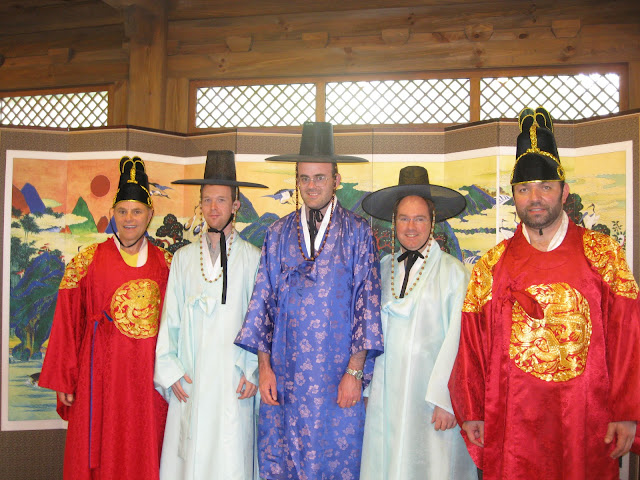 |
| Dressing up in Hanbok |
In the evening, I had a delicious Korean barbecue dinner with Don, Tom, and his wife and then moved my belongings to the residence of my host family in southwest Seoul, as I didn’t want to be carrying around heavy bags for the trip to Gyeongju. What I particularly enjoyed about this dinner was our waitress – a Chinese woman who spoke Japanese and works in a Korean barbecue restaurant! Since coming to Korea my Japanese language skills have proven useful more than once, and this was one of those times.
Don Womack brilliantly negotiated with Peter Park and made am arrangement to meet the group at Seoul station rather than at the Lotte Hotel at 7:00AM, so I sent a quick email the conference organizers to let them know not to expect me either. I really appreciate getting another 90 minutes of sleep! The train ride to Gyeongju took just two hours, and by 11:00AM were had arrived at the southeastern tip of Korea. Imagine being able to get across an entire country by train in just two hours. After arrival we were treated to lunch and then sightseeing commenced to the following sights:
These are all sights I visited on a day tour that I participated in back in 2005, so it was quite nostalgic to view them again. I remember back in 2005 when I was viewing the tombs in particular, thinking that I’d likely never in my life have another chance to view this particular scene. In retrospect it seems like just yesterday that I was in Korea. I believe it is healthy to live life to its fullest, but not necessarily with a sense of desperation, constantly wondering if you’ll never have a chance to visit someplace again in your lifetime. When I visited England and Paris in 1991 – the first time I ever went abroad – I remember thinking that I’d never have a chance to go abroad again. How wrong I was!
It was blazing hot on this day, with temperatures well into the 90s and the rays of the sun beating down without mercy. I regret losing my hat in Maui in February! Instead I decided to use my umbrella, which brought down the temperature a bit and protected me from the sun.
In the evening, we were treated to a delicious buffet meal hosted by the mayor of Gyeonju, followed by the second CMS composers concert with a special appearance by the The Gyeongju City Chorale.
Performances of New Music by CMS Composers II
Concert Manager: Kyong Mee Choi (Roosevelt University–Chicago)
Mei Votum ...................................... Da Jeong Choi (University of North Texas)
Seung Won Yoo, piano
Blitzkrieg ................................... Malcolm W. Rector (University of St. Thomas)
Malcolm W. Rector, piano
Shards ....................................... John C. Griffin (Western Michigan University)
Francesca M. Arnone, flute John C. Griffin, piano
8 Variations, One Crazy, on “Ah! Vous Dirai-je, Maman” .......... Giuseppe Lupis (Grand Valley State University) Hyunjung Rachel Chung, piano
Buffalo and Me .......................................... Ji Hyun Woo (Fredonia, New York)
You-Kyoung Kim, flute Ki Ho Kimi, changgo
Five Pieces on Korean Zen Poems ..........Daniel J. Perlongo (Indiana University of Pennsylvania)
Nanette Solomon & Susan Wheatley, piano four hands
A Program of Korean Choral Music featuring The Gyeongju City Chorale
Dohn Kim, Director Dong-Wook Kim, Assistant Director Sun-Hyung Lee, piano Ji-Hyun Kim, piano
On the morning Saturday, July 9th, I attended the following:
9:30 PAPER: Songs of Protest: Incorporating F&*@in USA by Yoon Min-suk into an American Music Course
Elizabeth Barkley (Foothill College)
10:00 PAPER: The Singing Revolution: Peaceful Protest through Song
Heather MacLaughlin Garbes (The Woodlands, Texas)
10:30 LECTURE-RECITAL: The Melding of Korean and Western Traditions
Francesca M. Arnone (Baylor University)
11:15 PANEL: Chinese Music/Western Music: Three Snapshots Michael B. Saffle (Virginia Polytechnic Institute & State University) James Deaville (Carleton University) Eric Hing-tao Hung (Westminster Choir College)
After lunch, I spent time preparing for my lecture at 3:15PM, “Composing for the Shakuhachi.” I am glad that I had time in the room beforehand, because there were some audio problems that needed to be addressed. If I hadn’t had an opportunity to check my sound, some of the sound excerpts from my Ipod would have been distorted.
In the evening, a number of us to a taxi downtown and found a delicious – an inexpensive – place to eat dinner. Walking around to enjoy the surroundings of Lake Bomun was out of the question, as it was pouring buckets of rain all day.
On the last day of the conference, I enjoyed John Robison’s presentation on “Lee Chan-Hae and Korean Pansori Composition in the Twenty-First Century.” In the afternoon, we had another sightseeing tour to the following sights:
Seokguram Grotto, Bulguksa Temple, & Folkcraft Village
Bulguksa Temple was just as spectacular as I remembered it when I first visited Gyeounju in 2005. However, the mayor of Gyeonju wanted use to see the city performance facilities so we didn’t have a chance to visit the Folkcraft Village.
 |
| Bulguksa Temple |
In the evening, we had another fabulous dinner at the Hyundai Hotel, supplemented by a magnificent performance of the Hahoe Byeolsin ‘Gut’ Mask Dance. It ended much earlier than anticipated, and Don and I were itching to do something, so we decided to enjoy the hotel bowling alley. It has probably been over 20+ years since I’ve been bowling, and I was just terrible. There were a couple of times that I bowled strikes –more of less by luck – and even once where I had two strikes in a row! Still I barely made over 100+ points and got beaten four out of four games.
 |
| Bowling a strike! |
I must applaud the organizers of this conference. I really didn’t imagine the extent of the details involved in planning a conference of this scope until I witnessed the day to day flow of events. To truly understand the amount of work involved I’d have to be a conference organizer myself (perhaps CMS International Conference in Japan someday!), but observing Peter Park and John Robison, along with Plaza 21 workers and others, heightened my respect for what it takes to organize a conference of this magnitude. At first, I thought that the $1,350 conference fee was quite expensive, but what I didn’t realize was how much it covered, such as meals, transportation, and the informative and well-organized sightseeing tours. When I travel I’m usually by myself and rarely take advantage of group tours. However, since we did so much in so little time, I can now understand the value of asking someone to organize a foreign abroad experience for you. On a professional note, I was happy to reunite with old colleagues and make some new ones, and I’m thrilled to have been a part of this magnificent week of sharing ideas, music, and experiencing Korean culture with my CMS colleagues.


